
Best Non-Toxic Kids Rain Gear in 2026: PFAS-Free Jackets, Boots & Suits
I have a son who would rather be outside than anywhere else on earth — streams, mud, puddles, rain, it doesn't matter. We've gone through more rain gear than I care to admit. And a few years ago, when I started researching non-toxic children's products more deeply, I realized something unsettling: the very jacket keeping my kid dry might be the one exposing him to harmful chemicals.
That discovery sent me down a research rabbit hole that changed how our family shops for outdoor gear. This guide pulls together everything I've learned — the science, the red flags, the brands that are genuinely doing it right, and the ones that just slap "eco" on the label.
⚠️ The Uncomfortable Truth About Rain Gear
A 2024 multi-country study by IPEN, Arnika, and CHEM Trust tested 72 clothing items — including children's coats — from 13 countries. 64% contained PFAS "forever chemicals." The most common chemical found? PFOA — a substance that is globally banned under the Stockholm Convention. The good news: 21 of the items tested were completely PFAS-free, proving safe alternatives exist and work just as well.
What's Really in Conventional Rain Gear
Most conventional rain gear contains a cocktail of chemicals that have no business being next to a child's skin. Here are the four main offenders:
☠️ PFAS / PFCs ("Forever Chemicals")
Used in DWR (Durable Water Repellent) coatings to make fabric shed water. PFAS don't break down — in the environment or in our bodies. They are found in virtually every human tested by the CDC. When a rain jacket warms up during wear or is washed, it releases PFAS into the air and water. Read our full PFAS guide →
☠️ PVC (Polyvinyl Chloride)
That shiny, plasticky look on budget rain gear? Almost certainly PVC. Smell a new shower curtain — that's what it smells like. PVC is rigid on its own, so manufacturers add softening agents: phthalates. Research by Toxic-Free Future and the EcoWaste Coalition found that 70% of vinyl rain gear items tested contained elevated levels of lead or cadmium — including a Mickey Mouse raincoat with 2,255 ppm of lead. The legal limit for toys is 90 ppm.
☠️ Phthalates
Added to PVC to make it flexible, phthalates are known endocrine disruptors — chemicals that mimic or block hormones in the body. A study by the Center for Health, Environment & Justice (CHEJ) found that 2 out of 4 children's raincoats tested had phthalate levels that would violate federal safety bans — if they were regulated as toys. They aren't, so it's completely legal. Phthalates transfer easily from fabric directly to skin.
☠️ Lead & Cadmium
Used as stabilizers in PVC and as pigments in colorful prints, heavy metals are a well-documented but underreported problem in children's rain gear. There is no safe level of lead exposure for children — it is a proven neurotoxin. Multiple independent studies have found lead in popular branded children's rain boots and jackets above 1,000 ppm. The safest material for boots is natural rubber, not vinyl.
🔬 A Note on "PFC-Free" vs. "PFAS-Free"
These terms are not identical and the difference matters. "PFC-free" typically refers to the elimination of long-chain perfluorocarbon chemicals. Many brands replaced these with short-chain PFAS alternatives — marketed as safer, but the EPA notes research on their long-term safety is still ongoing. "PFAS-free" is a broader, stronger claim covering the entire class. When possible, look for brands that explicitly state PFAS-free or fluorine-free — not just PFC-free.
Why Children Are More Vulnerable Than Adults
Rain gear sits directly against skin for hours — and children's bodies handle that exposure differently than adults.
🧠 Developing Brains & Organs
A 2025 review of 61 studies in Current Environmental Health Reports found that early-life PFAS exposure is linked to reduced cognitive, motor, and language development in infancy, and increased behavioral issues including hyperactivity in childhood.
🦠 Weakened Immune Response
Research published in early 2025 found children with high prenatal PFAS exposure had a 28% increased risk of common infections like ear infections. The National Academies of Science (2022) identified likely associations between childhood PFAS exposure and reduced antibody response to vaccines.
⚖️ Body Weight & Proximity
Children receive higher doses of chemicals relative to their body weight. They also spend more time close to the floor — where chemical dust settles — and are more likely to put clothing and zippers in their mouths. All of this amplifies exposure risk from the same product an adult might wear without concern.
For a deep dive into PFAS specifically, read our comprehensive guide: The Complete Parent's Guide to PFAS in Children's Products →
New Laws in 2025: What's Changed
🏛️ The Regulatory Landscape Is Finally Shifting
Two major state laws took effect on January 1, 2025, signaling a national turning point:
- New York State PFAS Apparel Ban: No person may sell any new apparel with intentionally added PFAS in New York. This includes outdoor apparel like rain jackets and pants. Starting 2028, even "severe wet conditions" outerwear (currently exempt) must comply.
- California AB 1817 (Safer Clothes & Textiles Act): As of January 2025, outdoor apparel sold in California containing PFAS above 100 ppm total organic fluorine must carry a label stating "Made with PFAS chemicals." A full phase-out is underway.
What this means for parents: brands selling nationwide are increasingly choosing to reformulate entirely rather than manage two product lines. This is accelerating the industry's shift away from PFAS — but until full compliance is universal, checking labels and buying from verified PFAS-free brands remains essential.
Materials Guide: Natural Rubber, TPU, PU — and PVC
The material label on a rain jacket or boot tells you a lot — if you know what to look for. Here's a plain-language breakdown:
| Material | Safety Level | Best For | Watch Out For |
|---|---|---|---|
| Natural Rubber | ✅ Best for boots | Rain boots, waders | Verify "100% natural rubber" — plain "rubber" can be synthetic and may contain heavy metals. Keep out of direct sunlight to prevent cracking. |
| TPU (Thermoplastic Polyurethane) | ✅ Best for jackets | Rain jackets, suits, seam tape | Gold standard for waterproof membranes. Inert, flexible, no PFAS needed. Verify phthalate-free in the product listing. |
| PU (Polyurethane coating) | ✅ Generally safe | Budget-friendly jackets and suits | Acceptable waterproofing — more common than TPU membranes. Still verify phthalate-free, as phthalates can appear in PU manufacturing. |
| Recycled Polyester (rPET) | ✅ Eco-friendly shell | Jacket outer shells | Used as the fabric shell, not the waterproof layer. Needs a coating (TPU, PU, or PFC-free DWR) to be waterproof. Verify the coating, not just the shell. |
| PVC / Vinyl | ❌ Avoid | Cheap boots, budget jackets | Requires phthalates to be flexible. Often contains lead and cadmium. Recognizable by a strong chemical smell. Look for #3, "V," or "vinyl" in material specs. |
Your Non-Toxic Rain Gear Shopping Checklist
✅ Look For
- Labels: PVC-free, PFAS-free, Phthalate-free, Fluorine-free DWR
- Waterproofing: TPU membrane, PU coating, Bionic-Finish® Eco, wax-based
- Fabrics: Recycled polyester (rPET), organic cotton, Sorona®, Tencel™
- Boots: "100% natural rubber" — not just "rubber"
- Certifications: OEKO-TEX® Standard 100, bluesign®, GRS (Global Recycled Standard)
- Transparency: Brand publishes full materials list and safety certifications
❌ Avoid / Question
- Materials: PVC, vinyl, phthalates, PFAS, fluorocarbons
- Vague claims: "Water-resistant" with no coating specified
- Smells: Strong chemical smell = likely PVC
- "PFC-free" only: Stronger brands say PFAS-free or fluorine-free
- No transparency: Can't find materials info on the brand's website
- Generic "rubber": For boots, always verify natural vs. synthetic rubber
Waterproof & Breathability Ratings Explained
When you see "10,000mm" or "5,000g" on a tag, here's what it actually means for keeping your child comfortable:
💧 Waterproof Rating (mm)
How much water pressure the fabric resists before leaking.
- 5,000 mm: Light rain, drizzle, quick errands
- 10,000 mm: Steady rain, extended outdoor play
- 15,000 mm+: Heavy downpours, sitting in puddles
For most kids, 5,000–10,000 mm is plenty. Sealed seams matter as much as the rating.
💨 Breathability Rating (g/m²/24h)
How much sweat vapor escapes — higher means less clammy during active play.
- 5,000 g: Low-energy activities, stroller walks
- 10,000 g: Active play, running, hiking
- 15,000 g+: High-intensity activity, sports
Active kids benefit most from higher breathability — clammy gear leads to cold kids fast.
How to Check the Rain Gear You Already Own
🔎 The 5-Step Check
- The smell test: Take the jacket or boot and smell it closely. A strong chemical odor — like a new shower curtain or inflatable pool toy — strongly suggests PVC. PFAS-free gear made from TPU or natural rubber has minimal smell.
- Look for the #3 symbol: On boots and accessories, a recycling triangle with "3," "V," or "PVC" in the label indicates polyvinyl chloride.
- Search the brand's materials page: Reputable brands publish their material composition online. If you can't find it after 5 minutes of searching, that's a red flag.
- Look for certifications on the tag: OEKO-TEX® Standard 100 means the finished product was tested for harmful substances including phthalates, heavy metals, and certain PFAS. bluesign® means the materials and manufacturing process meet safety standards.
- Contact the brand directly: Email or chat asking "Is this product PFAS-free, PVC-free, and phthalate-free?" Transparent brands are proud to confirm. Evasive or vague responses tell you something too.
If you already own gear that fails these checks, don't panic — prioritize replacement when it wears out, and limit use when possible. Outdoor use in fresh air reduces off-gassing compared to indoor storage in warm spaces.
Age-by-Age Buying Guide
Rain gear needs change significantly as children grow. Here's what to prioritize at each stage — plus the exact products we've personally tested and trust.
👶🧒 Babies, Toddlers & Preschool (0 months – 5 years)
From newborns in strollers to full-tilt puddle-jumpers, babies and toddlers have the highest chemical sensitivity and the closest contact with wet-weather gear. A few key principles for this age range:
- Stroller years (0–12 months): The priority is a PFAS-free, PVC-free stroller rain cover rather than clothing-based protection. Babies in carriers can wear a simple bunting or fleece under a parent's jacket.
- Walking toddlers (12 months+): One-piece rain suits are the gold standard. They eliminate the gap between jacket and pants that lets rain sneak in, and they're far easier to get on and off than separate pieces.
- Layer underneath: Reima's rubber rain gear is water-repellent but not insulating on its own — pair with a merino wool or fleece base layer in cold weather.
- Sizing tip: Reima sizes run about one size large. Order your child's current size for immediate fit, or go up one size to extend the season.
🍼 For Stroller-Age Babies: Start With the Rain Cover
Most conventional stroller rain covers are made from PVC — the same material found in cheap rain boots that's loaded with phthalates and lead. The clear plastic window is typically the worst offender, sitting right at baby's eye level. It's one of the most overlooked chemical exposures in the first year. The fix is straightforward:
Bumbleride Stroller Rain Cover
$$
One of the only stroller rain covers on the market explicitly certified PFAS-free, PVC-free, and phthalate-free. Made from water-resistant recycled nylon with a non-PVC clear window panel and magnetic peek-a-boo opening. Compatible with Bumbleride Indie, Speed, Era, and Indie Twin models (2018 and later). The transparent panels use a non-PVC plastic — a detail most brands quietly skip. If you have a Bumbleride stroller, this is the clear choice.
Reima Veteen Toddler Rubber Rain Suit
$$
Reima's most serious one-piece option for toddlers who mean business in the rain. Made from PVC-free rubber with a water column rating over 10,000 mm — meaning it holds up to sustained heavy downpours, not just drizzle. Sealed welded seams throughout. Free from PFAS and PVC. The rubber material means mud and grime literally rolls off, making cleanup effortless. This is the suit for kids who sit in puddles, not just walk through them. Works from late toddler age upward.

Oaki One-Piece Rain Suit
$$
One of the most popular toddler rain suits for outdoor loving families and little ones who go to nature school. PVC-free and BPA-free with a full-length front zip, thumb holes, and taped seams. Lighter and more packable than rubber rain gear — ideal for mild-to-moderate rain and year-round layering. Available from 18 months through kids' sizes.

CeLaVi Kids' Rain Suit
$$
A Scandinavian staple starting from 9–12 months (size 80 cm). DWR-free, PVC-free, phthalate-free, and lead-free. Available as a one-piece or a two-piece (jacket + bib overalls) — the bib overalls option is particularly useful for babies who have just started walking and need suspenders to keep pants up. Fully taped seams.
🥾 Boots, Hats & Mittens for Babies & Toddlers
A complete head-to-toe non-toxic setup makes rainy days effortless. Here's what we use and recommend — all PFAS-free, all PVC-free:
Reima Magisk Moomin Toddler Rain Boots
$$
Cotton-lined rubber wellies starting from size 4.5 Toddler — one of the smallest non-toxic rain boot options available. PVC-free, fluorocarbon-free, with a fully waterproof construction and the beloved Moomin characters printed on them. Comes with Reima's Happy Fit removable insole so you can check sizing without removing the boot. Available in pink/yellow and blue/orange. Pairs beautifully with the Moomin Plask rain set for a coordinated toxic-free toddler look.
Reima Rainy Kids' Rain Hat
$
The single most underrated piece of toddler rain gear. A properly waterproof hat keeps ears and the back of the neck dry — the parts most toddlers refuse to keep a hood on. Reima's Rainy hat is made from flexible, PVC-free material with welded seams (no stitching holes = no leaks). Lightweight, easy to stuff in a pocket, and available in 9 colors. Works from toddler through school-age sizing.
Reima Puro Rain Mittens
$
The finishing touch for wet-weather days. PVC-free with welded waterproof seams and a soft brushed polyester knit lining for warmth. The flexible material doesn't stiffen in cold weather, so these work on cool autumn and spring days too — with a thin liner glove underneath, they extend well into colder months. Reflective details for low-light visibility. Available in 9 colors.
Our Go-To Head-to-Toe Toddler Setup
For serious rainy-day play, this is the combination we keep coming back to: Reima Veteen one-piece suit over a merino wool base layer + Magisk Moomin boots + Rainy hat + Puro mittens. Every piece is PFAS-free and PVC-free, the rubber construction means cleanup is a quick rinse, and the Moomin theme makes getting dressed genuinely exciting. The only thing my son fights about is going back inside.
🧒 Still works at preschool age (3–5 years)
One-piece rain suits remain a great choice through preschool — they're easier for kids to put on independently and eliminate the jacket-and-pants gap where rain sneaks in. The Oaki and CeLaVi suits above both extend well into preschool sizing. When your child is ready to transition to separate pieces, head down to the school-age section below.
🎒 School Age & Preschool Separates (4–12 years)
When kids are ready for jacket + pants sets — usually around preschool or early school age — separate pieces give more flexibility for layering and let kids dress more independently. School-age gear needs to handle a daily commute, recess, and after-school adventures. Packability matters (jackets that compress into a bag), as does durability for pack-and-unpack cycles. Adjustable cuffs and a good hood are essential for independent dressing.

Reima Raincoats & Rain Pants
$$
100% PFAS-free and PVC-free, made with increasing amounts of bluesign®-approved and recycled materials. Reima's sizing runs large for longevity — we buy one size up. Their jacket + pants combination is the best value we've found for this age range. Durable enough for daily use in all weather.

Therm Kids SplashMagic Jackets
$$
Made from 100% recycled PET bottles. Free from PFAS, PFCs, and PVC, and compliant with California Prop 65. The "SplashMagic" color-change prints are a genuine hit with kids this age — a great motivator for getting dressed on rainy mornings.
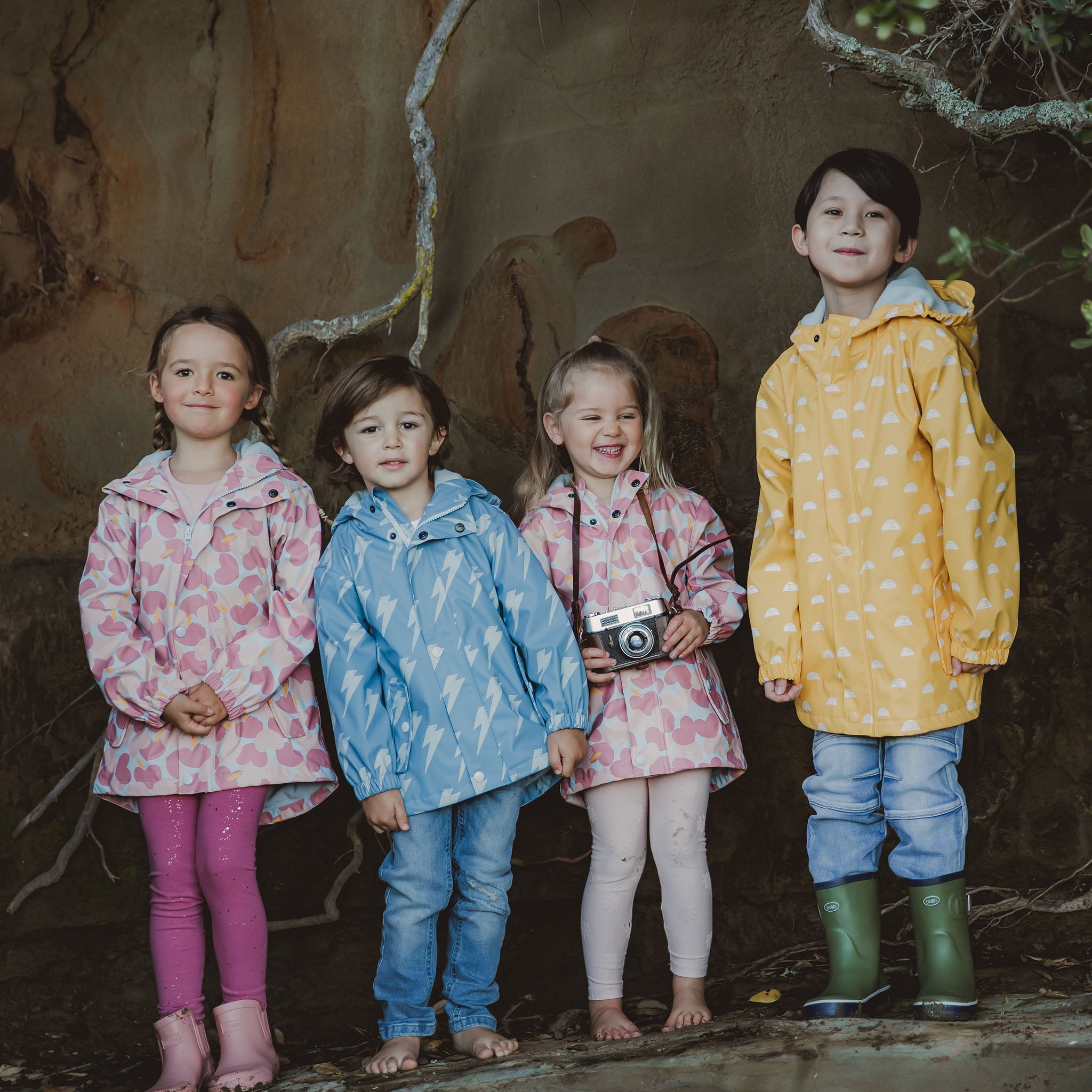
Snapper Rock Kids' Raincoats
$$$
A mom-founded brand making high-performance rainwear from recycled PET bottles. Free from PFCs, lead, and phthalates. The fit and quality is truly school-ready: structured, stylish, and tough enough for daily wear. Available exclusively at Nature Kids Co.

Quince Lightweight Rain Jacket
$
An excellent budget option for the school bag. OEKO-TEX® 100 certified, made with 45% recycled polyester and PFC-free DWR. Packs down small, great for keeping in a backpack for unexpected rain. Best for mild-to-moderate rain rather than heavy downpours.

Polarn O. Pyret Shell Jacket
$$$
Swedish brand with a philosophy of making one jacket that lasts long enough for three children. Uses PFC-free BIONIC-FINISH® ECO water repellence (inspired by the microstructure of lotus leaves — no chemicals needed). Designed to be passed down and resold.
All Our Tested & Verified Top Picks
Disclosure: This section contains affiliate links. We may earn a small commission from qualifying purchases at no added cost to you — this is how we fund our research and keep this guide updated.
| Brand | Type | Price | PFAS-Free | PVC-Free | Certifications | Ages |
|---|---|---|---|---|---|---|
| Reima | Jackets, pants, boots, suits | $$ | ✅ Yes (100%) | ✅ Yes | bluesign® | 0–16 yrs |
| Therm Kids | Jackets, suits, pants | $$ | ✅ Yes | ✅ Yes | CA Prop 65 | 1–14 yrs |
| Snapper Rock | Jackets | $$$ | ✅ PFC-free | ✅ Yes | Lead & phthalate-free verified | 2–14 yrs |
| Oaki | One-piece suits, jackets, pants | $$ | ✅ Yes | ✅ Yes (BPA-free) | — | 18 mo–12 yrs |
| CeLaVi | Suits, jackets, pants | $$ | ✅ Yes (DWR-free) | ✅ Yes | Phthalate & lead free | 9 mo–10 yrs |
| Polarn O. Pyret | Jackets, suits, pants | $$$ | ✅ PFC-free DWR | ✅ Yes | Recycled materials | 0–12 yrs |
| Helly Hansen | Jackets, pants, suits | $$ | ✅ PFC-free | ✅ Yes (Helox+) | — | 1–14 yrs |
| Quince | Jackets (packable) | $ | ✅ PFC-free DWR | ✅ Yes | OEKO-TEX® 100 | 4–14 yrs |
| Kamik | Rain boots | $$ | ✅ Yes | ✅ Yes | 100% recyclable | Toddler–kids |
| Lonecone | Rain boots | $ | ✅ Yes | ✅ Yes (natural rubber) | Natural rubber | Toddler–kids |
| Bumbleride | Stroller rain cover | $$ | ✅ Yes (explicit) | ✅ Yes (non-PVC window) | Phthalate-free, recycled nylon | 0–3 yrs (stroller) |
Sustainable Rain Jackets, Pants & Suits — Full Reviews
Reima Kids' Raincoats & Pants
$$
The benchmark for non-toxic rain gear. Reima has been making children's outdoor clothing since 1944 and every product in their line is 100% PFAS-free and PVC-free. Their materials are bluesign® approved, and the brand is committed to increasing recycled content across their range. We've tested multiple Reima products — the quality and durability is genuinely exceptional, with sizing designed to last multiple seasons.
Therm Kids All-Weather Jackets
$$
Made from 100% recycled PET bottles, free from PFAS, PFCs, and PVC, and fully CA Prop 65 compliant. The "SplashMagic" prints appear when the fabric gets wet — a genuinely magical moment that gets even reluctant kids excited about going outside in the rain. Packaging is 100% recycled or recyclable. A customer favorite that consistently earns rave reviews for longevity.
Snapper Rock Kids' Raincoats
$$$
A mom-founded brand transforming recycled PET bottles into premium-quality rainwear. Free from PFCs, lead, and phthalates, with independently verified safety. The construction quality is noticeably higher than mass-market options — sturdy zippers, reinforced seams, and a fit that handles active kids. Available here at Nature Kids Co.
Oaki One-Piece Rain Suit
$$
A go-to toddler rain suit for outdoor-loving families. PVC-free and BPA-free, with a full-length front zip, thumb holes, and taped seams. Works year-round — thin enough for spring and fall, and layerable over a fleece for winter use. Consistently well-reviewed by parents in the non-toxic parenting community.
CeLaVi Kids' Rain Suit
$$
A Scandinavian staple — DWR-free, PVC-free, phthalate-free, and lead-free, made with PU-coated polyester and fully taped seams. Available as a two-piece (jacket + pants or bib overalls) or one-piece from as small as 80 cm. One of the best value options for complete non-toxic coverage in all conditions.
Polarn O. Pyret Shell Jacket
$$$
Swedish brand whose stated design goal is one jacket worn by at least three children. Uses BIONIC-FINISH® ECO — a PFC-free DWR treatment inspired by the microstructure of lotus leaves. Made with recycled materials. The price per wear, when passed down, is extremely competitive.

Helly Hansen Rain Set
$$
Made with Helox+ — Helly Hansen's proprietary PVC-free waterproof PU material with full stretch for unrestricted movement. PFC-free. A highly durable option from a brand with deep roots in serious wet weather performance. Good for kids who need heavy-duty protection.
Quince Lightweight Rain Jacket
$
The best budget option we've found. OEKO-TEX® 100 certified, 45% recycled polyester shell with PFC-free DWR. Packs into its own pocket — great for keeping in a school bag. Best for moderate rain and mild temperatures rather than extended heavy downpours.
Pro Tip: Consider Waders for Stream-Loving Kids
For families who love streams, fishing, or swampy backyards, kids' waders are a game-changer. They keep kids warm and dry in deep, cold water that boots can't handle. While not perfectly sustainable due to synthetic construction, their multi-year durability reduces overall gear consumption. Our son wears his Oaki Kids' Neoprene Waders year-round — they've been the single most-used item in his outdoor wardrobe.

Sustainable & Non-Toxic Rain Boots
For boots, natural rubber is the gold standard. It contains no PVC, no phthalates, and no heavy metals — and it provides genuine grip and insulation. The key: always verify "100% natural rubber." Products listed as just "rubber" may be synthetic, which can carry many of the same risks as PVC.

Durability Spotlight: Reima Taika Boots
$$
The most durable boots we've tested — by a significant margin. The photo is real: my son's previous pair lasted two full years of very regular, very hard outdoor wear and were still in good enough shape to pass on when he outgrew them. We bought the same model immediately in the next size up. Made with 40% natural rubber with a vulcanized PVC-free rubber outsole — not 100% natural rubber, but completely PVC-free and phthalate-free. Cotton-lined, wide toe box, reflective strip. Built for kids who are genuinely tough on their gear. We order one size up to extend the life further.
Shop Reima BootsLonecone Natural Rubber Rain Boots
$
From a mama-owned brand, made from non-toxic natural rubber in playful patterns. One of our son's favorites — lighter everyday use option. Not quite as durable as Reima for heavy daily wear, but excellent value for lighter use and a genuine low-tox choice. The wide range of fun designs means kids actually want to wear them.
Kamik Riptide Rain Boot
$$
A standout eco-friendly option. Made from 100% recyclable synthetic rubber — PVC-free and phthalate-free. Manufactured in North America. When these boots reach end of life, they can be returned to Kamik's recycling program. A good choice if you want recyclability alongside safety.
Hatley Printed Rain Boots
$$
PVC-free natural rubber boots with vibrant, fun designs that kids love. Hatley also makes a full coordinating line of PFC-free rain jackets and pants — making it easy to build a matching, fully non-toxic set. The cotton lining adds comfort for longer wear.
Stonz Rubber Boots
$$
Non-toxic natural rubber free from lead, phthalates, PVC, and cadmium. Stonz holds podiatric certification from both the Canadian and American Podiatric Medical Associations — the only rain boot brand with this distinction, which validates their zero-drop design for healthy foot development. Note: we found durability less consistent for very active, rough-terrain use.
Rain Gear Accessories & Baby Essentials
Reima Veteen Toddler Rubber Rain Suit
$$
The highest-performance one-piece for toddlers. PVC-free rubber with a 10,000+ mm water column rating and fully welded seams. Built for heavy rain, snow, and serious puddle play. Mud and grime rolls right off the rubber exterior — cleanup is a quick rinse. PFAS-free throughout.
Reima Magisk Moomin Toddler Boots
$$
PVC-free, fluorocarbon-free rubber wellies starting from size 4.5 Toddler. Cotton-lined with the Happy Fit insole for easy size-checking. The Moomin prints make them an instant toddler favourite. Available in pink/yellow and blue/orange.
Reima Rainy Kids' Rain Hat
$
PVC-free flexible rubber hat with welded seams — no stitch holes means no leaks. Covers ears and the back of the neck. Lightweight enough to live in a coat pocket. Available in 9 colors, toddler through school-age sizing.

Reima Puro Rain Mittens
$
PVC-free waterproof mittens with welded seams and a warm brushed knit lining. Flexible in cold temperatures. Works as a rain shell over a warm liner glove in autumn and early winter. Reflective details for visibility in low light.
Bumbleride Stroller Rain Cover
$$
PFAS-free, PVC-free, and phthalate-free stroller rain cover made from recycled nylon with a non-PVC window panel. Compatible with Bumbleride Indie, Speed, Era, and Indie Twin (2018+). The non-PVC clear window is the detail that sets this apart — most stroller covers use PVC plastic right at baby's eye level.

Hatley Kids' Umbrellas
Wooden handles, PFC-free canopy fabric, and fun prints. One of the few umbrella brands that explicitly publishes their PFC-free status — most umbrella brands don't. A detail that matters for products handled daily by children.
Budget Guide: Safe Rain Gear at Every Price Point
Non-toxic rain gear doesn't have to break the budget. Here's what we'd recommend at each tier:
| Budget | Best Pick | Approx. Price | Best For |
|---|---|---|---|
| $40–80 | Oaki One-Piece Suit / CeLaVi Set / Quince Rain Jacket | $40–75 | Toddlers, all-weather coverage, daily use; Quince great for school bags and light rain |
| $80–130 | Therm Kids / Reima Jacket + Pants | $85–120 | Heavy rain, active kids, multi-season use |
| Premium / Pass-Down | Polarn O. Pyret / Reima Boots | $120–180 | Best long-term value when passed to younger siblings |
On Cost: The Most Sustainable Choice Is What You Already Own
If you have rain gear that works and isn't due for replacement, use it. The environmental cost of manufacturing new gear — even eco-friendly gear — is real. When it's time to replace, that's the moment to upgrade. Buying quality once, sizing up to extend the life, and passing gear to the next child or family is the most sustainable approach of all.
How to Care for Your Eco-Friendly Rain Gear
Proper care dramatically extends the life of non-toxic rain gear — and preserves the waterproofing that makes it work.
🧺 Care Essentials
- Wash on cold, gentle cycle. Hot water and harsh detergents degrade waterproof coatings. Use a gentle, fragrance-free detergent — or a specialized cleaner like Nikwax Tech Wash.
- Tumble dry on low to reactivate DWR. Heat reactivates the DWR coating. After washing, 20 minutes on low heat is more effective than air drying at restoring water repellency.
- Re-apply DWR when water stops beading. Do the "bead test" — sprinkle water on the jacket. If it beads and rolls off, the DWR is working. If it soaks in, it's time to re-treat. Use Nikwax TX.Direct or Grangers Performance Repel — both are PFC-free and washable.
- Air dry completely before storing. Storing damp gear causes mildew and degrades materials faster. Hang to finish drying after any machine cycle.
- Store hanging, not compressed. Storing jackets in stuff sacks or tightly compressed for extended periods weakens the waterproof membrane. Hang or lay flat for seasonal storage.
The Bottom Line
Rain gear sits against your child's skin for hours, warms up, gets chewed on, and is washed repeatedly — releasing whatever's in it into the air, water, and your child's body over time. Knowing what to look for (and what to avoid) is genuinely worth the 10 extra minutes of research before you buy.
The good news is that the brands getting it right are getting better every year — and the 2025 regulatory changes in New York and California are pushing the rest of the industry in the right direction. For a full picture of how PFAS affect children's health across all product categories, see our comprehensive guide: The Complete Parent's Guide to PFAS in Children's Products →
Now go outside. There's no such thing as bad weather — only the wrong gear.
Frequently Asked Questions
Research & Sources
Every fact in this guide is supported by peer-reviewed research or reporting from established scientific and regulatory organizations. Key sources:
- IPEN / Arnika / CHEM Trust (2024) — PFAS Found in Outerwear Globally: 64% of 72 samples tested positive for PFAS including globally banned PFOA.
- Ames et al., Current Environmental Health Reports (2025) — Early-life PFAS Exposure and Child Neurodevelopment: Review of 61 studies linking PFAS to cognitive and behavioral effects in children.
- U.S. Right to Know (2025) — PFAS and Children's Immune Function: High prenatal PFAS exposure linked to 28% increased infection risk.
- Toxic-Free Future / EcoWaste Coalition — Hazardous Chemicals in Children's Rain Gear: 70% of vinyl rain gear contained elevated lead or cadmium.
- Environmental Working Group (2022) — PFAS in Baby Textile Products: All 34 samples showed fluorine indicators; outerwear among highest-fluorine categories.
- U.S. EPA — Human Health and Environmental Risks of PFAS: Official government overview of documented health effects.
- New York State DEC — PFAS in Apparel Law: Details of NY's ban on intentionally added PFAS in apparel, effective January 1, 2025.
- CHEM Trust (2024) — Banned PFAS Found in Children's Clothing Worldwide: Testing results from 13 countries.
- Nature Kids Co. — The Complete Parent's Guide to PFAS in Children's Products.
Last Updated: February 2026 | All product safety claims verified directly with brand websites at time of publication. Product formulations and certifications can change — always verify current claims with the brand before purchasing.